
A property is fairly priced when its figure can be supported by relevant comparable evidence, reasoned adjustments and the transaction’s actual risks. The listing price, a broad price-per-square-metre average and an automated estimate are not enough.

The asking price is not proof of market value
An asking price reflects the seller’s expectations and marketing strategy. It may be aligned with the market, include negotiating room or rely on a reference that is no longer comparable. It does not show what similar homes ultimately sold for or under which conditions.
Property portals are useful for understanding active competition, but listings are offers rather than completed transactions. The relevant question is which genuinely comparable properties support the figure and what adjustments are needed.
Price per square metre is a shortcut, not a valuation
A simple division may mix usable area, built area, shared elements, terraces and measurements reported on different bases. It also says nothing about how the space works. A bright, efficient 100-square-metre home is not automatically equivalent to one dominated by corridors, internal rooms or major works.
A city or district average is too broad for a specific decision. In Madrid and other dense urban markets, one section of a street, a higher floor or a different building type can change the relevant buyer pool.
A comparable must resemble the property where value is created
Start with the same micro-location and a reasonably similar type of home. Then account for floor level, lift, external aspect, light, views, noise, terrace, parking, condition, building quality, layout, size and the date of the evidence.
The exercise is not about collecting three listings with similar floor areas. It is about explaining why a buyer would choose one over another. If every comparison requires major corrections, the evidence is weak.
Premium features do not carry a fixed value
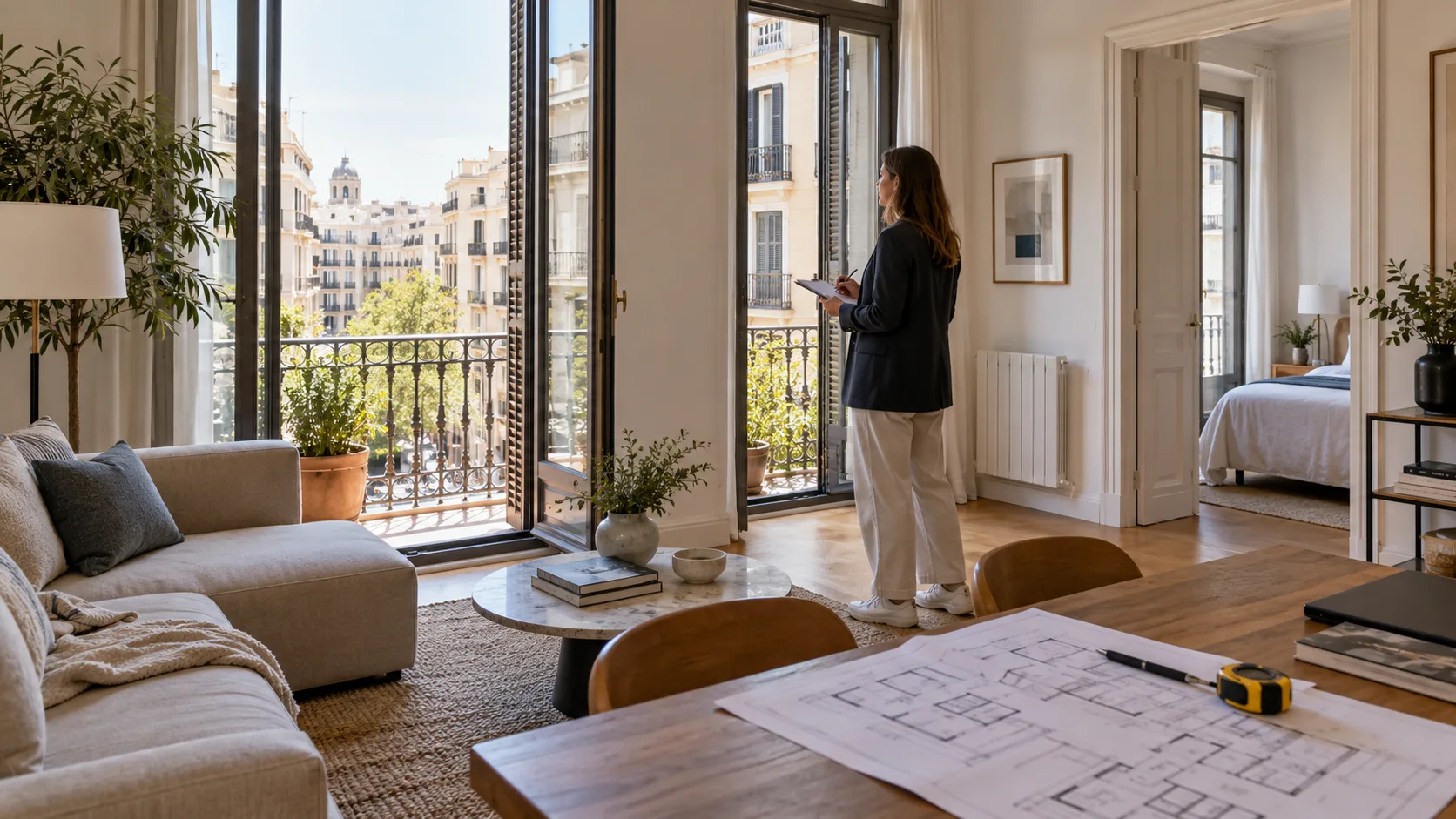
A terrace can be scarce and highly desirable, yet add much less if it is narrow, noisy or difficult to use. A recent refurbishment cannot justify any premium when the layout is poor or the specification falls short of the segment. A high floor without a lift is different from a high floor in a well-maintained landmark building.
Adjustments depend on scarcity, current demand and the alternatives available; they should not be applied from an automatic price list.
The visible renovation budget is only part of the adjustment
A property requiring work involves construction, professional fees, permits where applicable, time, contingencies and a period in which the home may not be usable or lettable. Equally, it is unreasonable to deduct a complete renovation merely because the finishes do not match a buyer’s taste.
Separate routine maintenance, cosmetic updating, reconfiguration and defects. Technical inspection and document review may reveal factors that change both cost and willingness to proceed.
The building and the paperwork influence value
The flat cannot be assessed in isolation from the building. Special assessments, planned works, accessibility, lift, façade and roof condition, owners’ association minutes and ordinary charges affect future expenditure and risk. A perfect interior does not remove an important building-level liability.
Title, charges, occupation, licences and consistency between the physical property and its records also matter. Price analysis does not replace technical or legal due diligence; it depends on them.
A mortgage valuation serves a different purpose
A regulated valuation is essential for many financed purchases because the lender uses it to assess its security. It does not replace the buyer’s pre-offer analysis or automatically establish that the asking price is attractive. It may arrive after negotiation and does not necessarily capture the buyer’s alternatives or strategy.
Market analysis, mortgage valuation and agreed price are related but distinct. Treating them as interchangeable creates false reassurance.
A defensible offer is not a standard percentage discount
There is no universal reduction that applies to every property. A well-prepared offer connects the evidence-based range with current competition, time on market, the seller’s circumstances, outstanding checks and the proposed conditions.
Sometimes value lies in the price; sometimes in timing, vacant possession, included items or a protective condition. Good negotiation is not simply starting as low as possible. It means preserving credibility, protecting confidential budget information and retaining a realistic route to agreement.

Our pre-offer analysis framework
◆ 1. Define the exact asset
Confirm area, ancillary spaces, condition, occupation, included items and available records before comparing.
◆ 2. Set the micro-location
Use the street section and immediate environment competing for the same buyer rather than a district-wide average.
◆ 3. Select genuine comparables
Prioritise recent evidence and similar property types, sizes and buildings; reject references requiring excessive adjustments.
◆ 4. Separate listing from sale evidence
Treat listings as active competition and, where possible, contrast them with transaction evidence and first-hand market knowledge.
◆ 5. Adjust relevant attributes
Assess floor, light, external aspect, layout, condition, terrace, parking, views, noise, lift and building quality without rigid formulas.
◆ 6. Add cost and risk
Include renovation, building assessments, documentation discrepancies, timing and contingencies the buyer would assume.
◆ 7. Build a range
Set out a reasoned interval rather than false precision and identify the information capable of moving it.
◆ 8. Establish the walk-away point
Keep property value separate from the maximum budget and decide when price or conditions cease to make sense.
◆ 9. Turn the analysis into an offer
Choose amount, conditions, validity period, pending evidence and counter-offer strategy; where appropriate, make the offer expressly subject to a satisfactory IRE report.
The aim is not to guess the seller’s lowest number
It is to decide what makes sense to offer, on which terms and where to stop without confusing desire, budget and value.
If you would like us to guide you through the whole process, discover our buyer’s agent services.
Related articles
- How much does a buyer’s agent cost in Spain? What determines the fee
- The agent showing you a property: are they representing you?
- Property viewing checklist: 25 checks before you buy
| HOW LORA GALEVA HELPS |
| Build the evidence before negotiating the number. |
| Ask us for more information → |